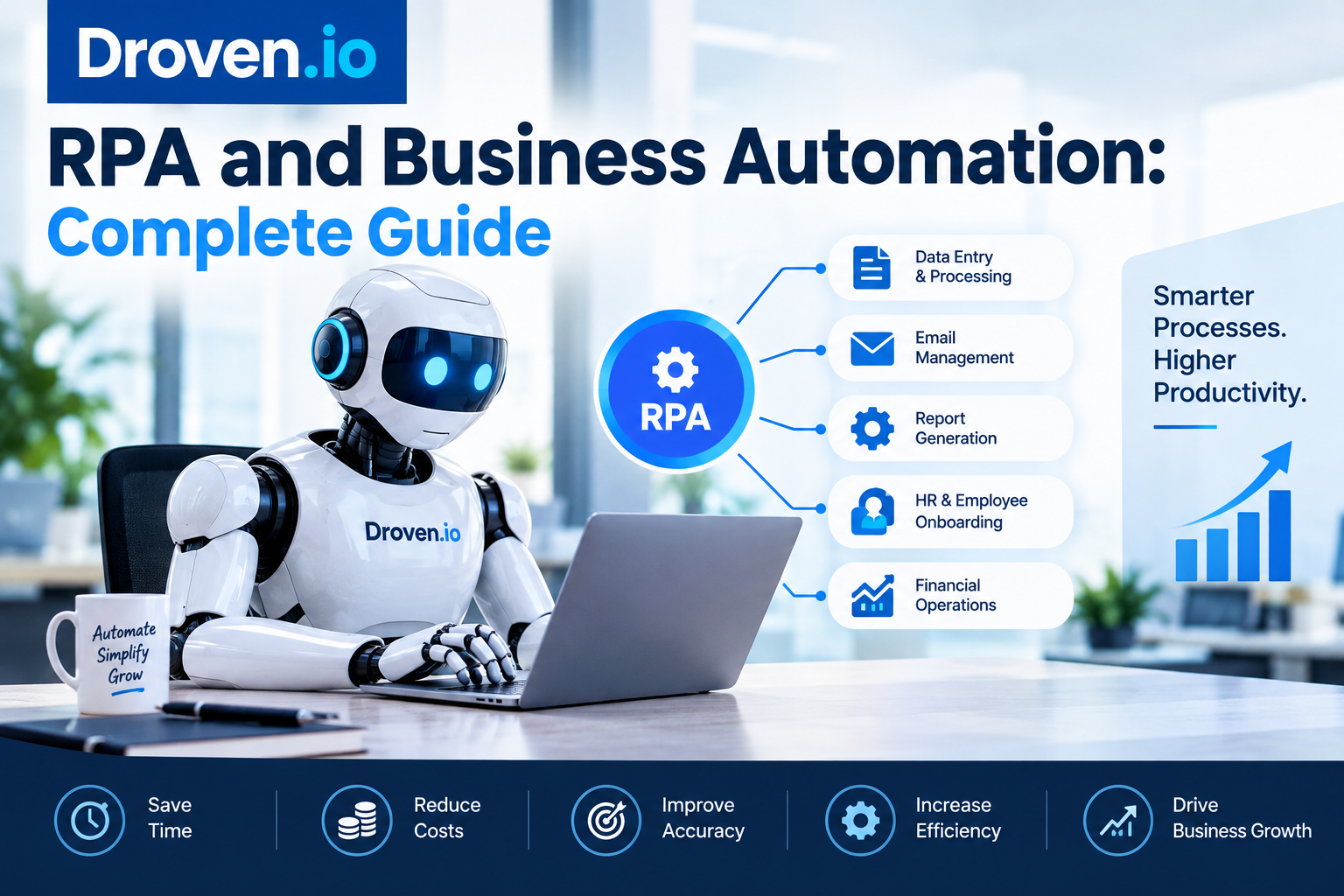
Introduction
Running a business involves more than selling products or providing services. Behind every successful company, there are numerous daily activities, including managing customer information, processing orders, preparing invoices, updating records, and communicating with employees. When these tasks are handled manually, they can consume valuable time and slow down business operations.
This is where RPA and become useful. These technologies help companies reduce repetitive work, improve accuracy, and organize their daily operations. Instead of asking employees to perform the same administrative tasks repeatedly, businesses can use software to handle many routine activities.
Droven.io provides an educational perspective on artificial intelligence, automation, and emerging technologies, helping readers understand how these developments relate to modern business operations. Understanding the fundamentals of automation can help business owners make more informed decisions before investing in new technology.
But what exactly is robotic process automation, how does business automation work, and what practical benefits can companies expect? Let’s explore these questions in detail.
What Is RPA and Business Automation?
Robotic Process Automation (RPA) is a technology that uses software robots, commonly called bots, to perform repetitive tasks on computers. These bots follow predefined instructions to complete activities that would otherwise require human interaction.
For example, imagine a company that receives hundreds of customer orders every day. An employee might need to open each order, copy customer information, update a spreadsheet, and prepare an invoice.
An RPA bot can perform many of these steps automatically, provided the process follows clear rules and the necessary systems are accessible.
Business automation is a broader concept. It involves using technology to manage or improve entire business processes rather than automating only individual tasks.
These processes may include:
- Customer relationship management.
- Invoice processing and payment records.
- Employee onboarding.
- Inventory management.
- Order tracking and processing.
- Email notifications.
- Data collection and reporting.
RPA can become one part of a larger business automation strategy. When different tools and systems work together, companies can create more organized workflows with fewer manual steps.
According to IBM’s explanation of business automation, business automation uses technology to streamline repetitive operations and allow employees to concentrate on higher-value activities.
How Does Robotic Process Automation Work?
RPA works by following instructions configured by a developer or automation specialist. Depending on the software, bots can interact with websites, desktop applications, databases, and other business systems.
They can perform actions such as clicking buttons, entering information, downloading documents, copying data, and generating reports.
Understanding the Automation Process
Consider an online business that receives customer orders through its website.
Without automation, an employee may need to:
- Check the new order.
- Copy the customer’s details.
- Update the inventory system.
- Prepare an invoice.
- Send an order confirmation.
With an appropriately configured RPA workflow, a software bot can complete these routine steps automatically.
The process generally follows three stages:
1. Input collection: The bot receives information from a website, application, spreadsheet, or another connected system.
2. Task execution: It follows predefined rules to process information and complete the required actions.
3. Output and reporting: The bot updates records, generates documents, sends notifications, or reports problems that require human attention.
However, automation does not mean that every decision can be handled without people. Unusual orders, missing information, payment disputes, and other exceptions may still require human review.
Key Benefits of RPA and Business Automation
Automation is not simply about completing tasks faster. Its real value comes from making business operations more consistent and giving employees more time to handle work that requires experience and judgment.
Here are some important benefits businesses can achieve.
1. Reduced Manual Work
Employees often spend hours completing repetitive activities that follow the same pattern. These activities can include entering customer details, checking order information, preparing documents, and updating records.
RPA can handle many of these responsibilities without requiring employees to repeat every step manually.
For example, an accounting department can automate the collection of invoice information and organize it for further processing. Employees can then spend more time reviewing financial information instead of copying data between applications.
2. Improved Data Accuracy
Manual data entry can lead to mistakes, especially when employees work with large amounts of information.
A properly configured automation system follows consistent instructions. This can reduce common mistakes, such as entering incorrect customer details or forgetting to update a record.
However, automation is only as reliable as its instructions and input data. Incorrect rules can produce incorrect results on a much larger scale.
3. Better Customer Experience
Customers generally expect businesses to respond quickly and provide accurate information.
Automation can help companies send order confirmations, provide delivery updates, organize customer requests, and manage routine inquiries.
For instance, an online store can automatically send an email when an order is received. Another automated process can notify the customer when the order is dispatched.
These small improvements make communication more organized without requiring employees to send every notification manually.
4. Lower Operational Costs
Businesses spend money on employee time, administrative activities, software, and other operational requirements.
RPA can reduce the amount of manual effort needed for suitable repetitive processes. This may help companies manage their resources more effectively.
However, automation also involves costs, including software subscriptions, implementation, maintenance, and employee training. Companies should calculate the total cost before deciding whether a process should be automated.
5. Improved Productivity and Scalability
A business may receive a manageable number of orders during ordinary periods but experience much higher demand during seasonal sales.
Manual processes can become difficult to manage when workloads increase.
Automated workflows can handle additional tasks according to their configured capacity. Businesses can also monitor automated activities and identify areas where additional improvements are needed.
Practical Applications of Business Automation Across Different Industries
RPA is not limited to large technology companies. Small businesses, online stores, financial departments, healthcare organizations, and manufacturing companies can all benefit from suitable automation processes.
The important thing is to identify repetitive activities that follow clear rules.
E-commerce and Online Businesses
Online businesses manage several activities simultaneously. They receive orders, update product information, communicate with customers, and manage inventory.
Business automation can connect these activities through structured workflows.
For example:
- Automatically record new customer orders.
- Update inventory after a confirmed purchase.
- Send order confirmation emails.
- Generate routine sales reports.
- Notify staff about low-stock products.
This allows business owners to focus on product quality, marketing, and customer relationships.
Banking and Financial Services
Financial organizations work with large amounts of sensitive information. Accuracy and proper record management are essential.
Automation can support activities such as invoice processing, transaction reconciliation, document verification, and routine reporting.
For example, a finance team can use an automated workflow to collect information from invoices and send records for approval.
Sensitive financial decisions should still involve appropriate human checks and security controls.
Healthcare Organizations
Healthcare providers handle appointments, patient records, billing information, and administrative documentation.
Automation can support administrative activities without replacing medical professionals.
Some practical examples include:
- Appointment reminders.
- Patient registration workflows.
- Insurance document processing.
- Administrative report preparation.
- Billing notifications.
Medical decisions, diagnosis, and treatment planning require qualified healthcare professionals.
Manufacturing and Supply Chain Management
Manufacturing companies depend on organized production schedules, inventory records, supplier communication, and quality checks.
Automation can help connect different departments and improve the flow of information.
For example, when inventory reaches a predefined level, an automated system can notify the purchasing department. Staff members can then review the requirement and approve a new purchase order.
This approach reduces unnecessary manual monitoring while keeping people involved in important decisions.
RPA vs. Traditional Business Automation
Although these terms are closely related, they do not describe exactly the same thing.
RPA focuses on automating individual tasks through software bots. Traditional business process automation often focuses on connecting multiple activities into a complete workflow.
| Feature | RPA | Business Process Automation |
|---|---|---|
| Main purpose | Automates repetitive tasks | Connects complete workflows |
| Typical example | Entering invoice data | Managing the invoice approval process |
| Scope | Individual activities | Multiple connected activities |
| Human involvement | Depends on the task | Depends on the workflow |
| Technology | Software bots | Workflow platforms, integrations and other tools |
For example, an RPA bot might extract information from an invoice and enter it into an accounting application.
A broader business automation system could manage the entire process, including invoice submission, approval, payment scheduling, and record updates.
How Artificial Intelligence Is Changing Business Automation
Artificial intelligence is expanding what automation systems can do.
Traditional RPA generally follows predefined instructions. It performs particularly well when information is structured and tasks have predictable outcomes.
AI introduces additional capabilities, including working with natural language, recognizing patterns, classifying documents, and processing information that does not always follow an identical format.
Consider a company that receives customer inquiries through email.
A traditional automation workflow might identify specific words in an email and send a predefined response.
An AI-supported workflow could interpret the customer’s message, identify its general purpose, and suggest an appropriate response for an employee to review.
Combining AI with RPA can therefore support more complicated business processes.
However, AI-generated information is not always correct. Businesses should use human approval for important decisions, particularly when customer information, financial records, or confidential documents are involved.
Challenges Businesses Should Consider Before Automating
Despite its benefits, automation is not a perfect solution for every business problem.
Understanding its limitations is essential before investing in new technology.
Initial Implementation Costs
Some automation platforms require subscriptions, technical expertise, and integration work.
Small businesses should begin with a process that has a clear operational benefit rather than automating everything immediately.
Changing Business Processes
RPA bots generally depend on predefined instructions. If an application changes its layout or a company modifies its workflow, an existing bot may stop working correctly.
Regular maintenance is therefore necessary.
Data Security and Privacy
Automation systems may interact with customer details, financial information, and internal business documents.
Companies should apply appropriate access permissions, encryption, monitoring, and data protection practices.
Employee Training
Employees need to understand how automated processes work, when human intervention is necessary, and how to report problems.
Automation should support employees rather than create confusion about their responsibilities.
How to Start Using RPA and Business Automation
A successful automation strategy does not need to begin with a complicated system. Businesses can start with a simple process and gradually expand their automation activities.
Here is a practical approach.
Identify repetitive tasks: Examine everyday activities and identify tasks that consume time but follow predictable instructions.
Measure the current process: Record how long the task takes, how frequently it occurs, and how often mistakes happen. These measurements will provide a useful comparison after automation.
Select suitable software: Compare automation platforms based on their features, security, compatibility, pricing, and maintenance requirements.
Start with a small project: Automate one well-defined process, such as invoice data entry or routine email notifications.
Monitor the results: Check whether the automated process improves accuracy, reduces processing time, and creates measurable value.
Improve gradually: Use feedback from employees and customers to identify additional opportunities.
Microsoft’s automation adoption guidance also discusses the importance of managing automation as an organized business initiative.
The Role of Droven.io in Understanding Modern Automation
Understanding new technologies can be challenging, particularly for business owners who do not have a technical background.
Droven.io covers artificial intelligence, digital transformation, emerging technology, and AI-driven business processes. Its editorial content provides readers with information about developments that are changing the way organizations operate.
For someone exploring RPA and business automation, learning the basic concepts is a useful starting point.
Before selecting an automation platform, it is important to understand what a particular technology can do, where it has limitations, and whether it addresses an actual business requirement.
Readers can explore relevant topics through the Droven.io website, including its AI and business technology coverage.
The goal should not be to adopt automation simply because it is becoming popular. Instead, businesses should understand their operational challenges and select technologies that address those needs.
Frequently Asked Questions (FAQs)
1. What is RPA in business automation?
RPA stands for Robotic Process Automation. It uses software bots to perform repetitive, rule-based computer tasks, such as data entry, document processing, and updating business records.
2. How does business automation help small businesses?
Business automation helps small businesses organize repetitive activities, reduce manual work, improve record management, and manage customer communication. It can also help employees concentrate on important business activities.
3. Does RPA require programming knowledge?
Not always. Many modern RPA platforms offer visual workflow builders and low-code or no-code features. However, complex automations and integrations may require programming or technical expertise.
4. Can RPA replace human employees?
RPA can automate certain tasks previously performed by employees, but it does not replace the judgment, creativity, communication, and decision-making required in many jobs. Its primary purpose is to automate suitable repetitive activities.
5. What is the difference between RPA and AI?
RPA follows predefined instructions to perform tasks, while AI can analyze information, recognize patterns, and generate responses. The technologies can also work together to support more advanced automation processes.
6. Which business processes are suitable for RPA?
Processes that are repetitive, rules-based, and involve structured information are generally suitable. Examples include invoice processing, data entry, report generation, order updates, and routine notifications.
7. Is business automation expensive?
Costs depend on the software, number of automated processes, implementation requirements, and maintenance. Some businesses can begin with affordable tools, while larger automation projects may require substantial investment.
8. How can a business measure automation success?
Businesses can monitor processing time, error rates, operating costs, employee workload, and customer response times. Comparing these measurements before and after implementation helps determine whether automation is delivering value.
Conclusion
RPA and business automation are changing how organizations manage everyday operations. From processing invoices and updating customer records to managing inventory and sending notifications, automation can reduce repetitive work and create more organized business processes.
However, successful automation requires more than choosing software and configuring bots. Businesses must understand their existing workflows, protect sensitive information, train employees, and monitor performance.
For companies exploring digital transformation, learning about RPA, artificial intelligence, and workflow automation is an important first step. Platforms such as Droven.io provide an opportunity to explore these technologies and understand their growing role in modern business.
The real value of automation is not simply doing more work in less time. It is creating business processes that are reliable, manageable, and capable of supporting long-term growth.


Pingback: Photography Business Tools: Essential Equipment & Software
Pingback: Logistics Business Category Classification: Complete Guide