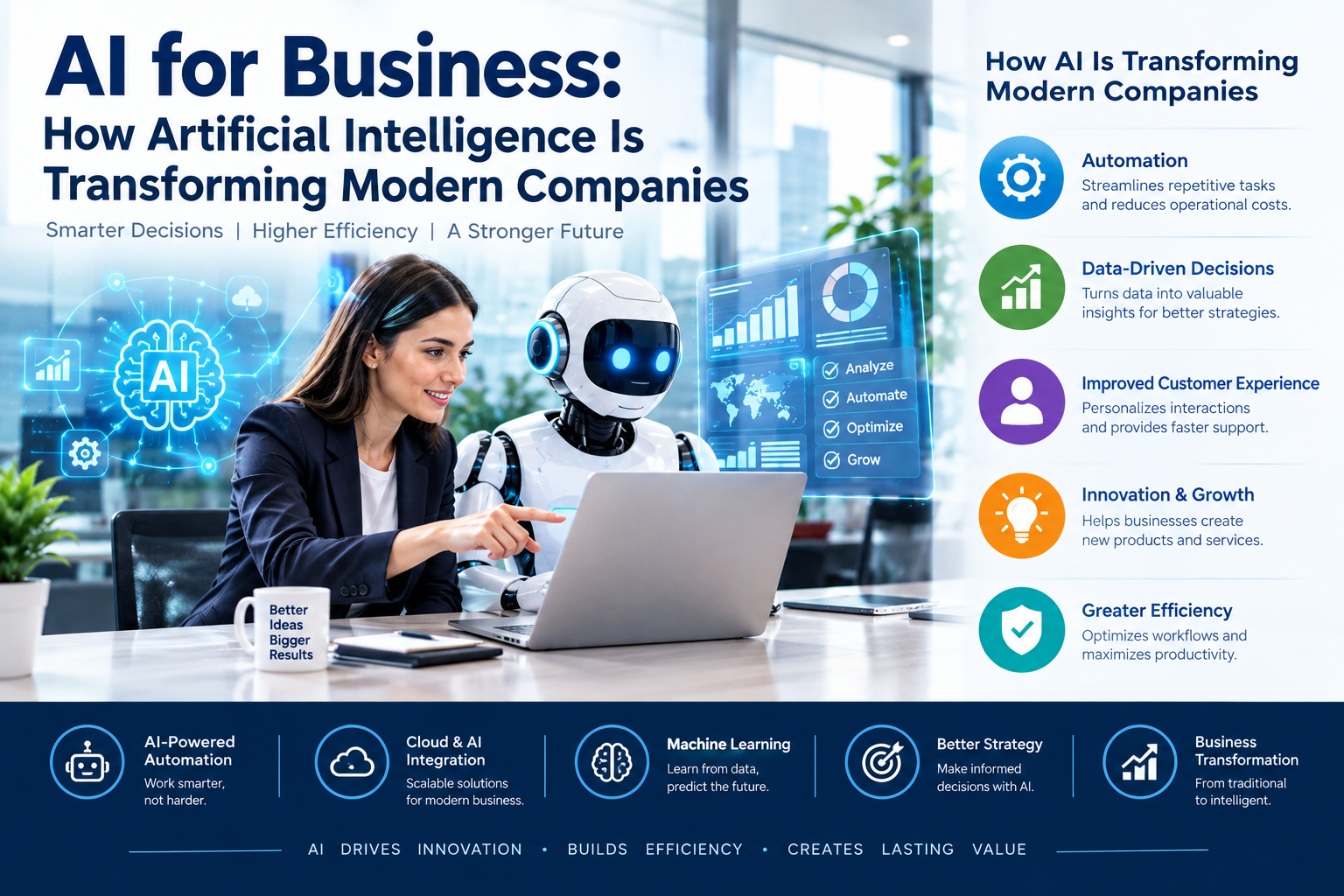
Artificial intelligence is changing how businesses work, make decisions, and serve their customers. Companies of all sizes are using AI to save time, improve productivity, and manage daily operations. Tasks that once required hours of manual work can now be completed with the help of intelligent software.
AI for business is no longer limited to large technology companies. Small businesses, online stores, marketing agencies, financial institutions, and manufacturers are also adopting AI solutions. These tools help companies understand customer behavior, analyze data, automate routine tasks, and discover new opportunities.
However, using AI is not simply about installing new software. Businesses need to understand their goals, choose the right tools, and use technology responsibly. When implemented correctly, artificial intelligence can become a valuable part of a company’s growth strategy.
What Is AI for Business?
AI for business refers to the use of artificial intelligence to improve business activities, solve problems, and support decision-making. It allows computer systems to perform tasks that normally require human intelligence.
These tasks include understanding customer questions, analyzing information, recognizing patterns, and generating recommendations.
AI for Business helps companies improve their daily operations and make better decisions.
Businesses can use AI in several areas, including:
- Customer service and communication
- Digital marketing and advertising
- Sales and lead generation
- Financial management
- Data analysis
- Inventory management
- Human resource management
- Business process automation
For example, an online store can use an AI-powered chatbot to answer common customer questions. A marketing team can use AI software to study customer behavior and improve advertising campaigns.
The goal is not always to replace employees. Instead, AI helps workers complete certain tasks more efficiently so they can focus on activities that require human judgment, creativity, and experience.
How Artificial Intelligence Is Changing Business Operations
Traditional business operations often involve repetitive tasks, manual data entry, and time-consuming processes. These activities can reduce productivity and increase operating costs.
Artificial intelligence offers practical ways to improve these processes and make daily work more efficient.
Small businesses can use AI for Business to save time and reduce operational costs.
One major advantage of AI for Business is its ability to automate repetitive tasks.
Automating Repetitive Tasks
Automation is one of the most useful applications of AI in business. Intelligent software can handle routine activities that previously required manual effort.
For example, AI-powered systems can:
- Organize incoming emails.
- Extract information from documents.
- Process basic customer requests.
- Prepare routine business reports.
- Sort and categorize business records.
Consider a company that receives hundreds of customer emails every day. Employees may spend several hours sorting messages and identifying common questions.
An AI-powered system can organize these messages and suggest suitable responses. Employees can then spend more time solving complex customer problems.
This approach can reduce repetitive work and make daily operations easier to manage.
Improving Business Decision-Making
Business decisions often depend on information collected from different sources. Reviewing large amounts of data manually can be difficult and time-consuming.
AI tools can analyze business information and identify patterns that may otherwise go unnoticed.
AI for Business also helps companies understand customer needs and improve their services.
For example, a retail company can use AI to examine previous sales, customer preferences, and seasonal demand. The system can help identify products that may sell well during certain periods.
Managers can use these insights to improve purchasing and inventory decisions.
However, AI recommendations should not replace human judgment. Business leaders must review important findings and consider factors that automated systems may overlook.
Top Applications of AI for Business
Artificial intelligence can support almost every major business department. The most suitable applications depend on a company’s industry, size, and operational needs.
Many companies are adopting AI for Business to increase productivity and support business growth.
1. AI in Customer Service
Customer service plays an important role in building trust and maintaining long-term relationships. However, answering similar questions repeatedly can take up valuable employee time.
AI for Business is changing how modern companies manage data, marketing, and customer relationships.
AI-powered chatbots and virtual assistants can help businesses manage basic customer interactions.
They can answer questions about:
- Product features
- Shipping and delivery
- Return policies
- Account information
- Frequently asked questions
For example, an online business can add a chatbot to its website. Customers can ask questions at any time and receive automated answers to common requests.
More complicated issues can be transferred to human support representatives.
This approach helps businesses manage customer inquiries while allowing employees to focus on problems that require personal attention.
2. AI in Digital Marketing
Digital marketing involves understanding customer interests, creating useful content, and reaching the right audience.
AI tools can support these activities by analyzing customer behavior and identifying useful patterns.
Businesses can use AI for:
- Content research and planning
- Audience segmentation
- Advertising analysis
- Email marketing
- Keyword research
- Campaign optimization
For example, a digital marketing agency can analyze campaign data to understand which advertisements attract more visitors.
AI can also help marketing teams generate content ideas, research topics, and prepare initial drafts. However, human editing remains important for accuracy, originality, and brand identity.
3. AI in Sales and Lead Generation
Finding potential customers is an important part of business growth. Sales teams often spend considerable time researching prospects and organizing customer information.
AI-powered sales tools can make this process easier.
They can analyze customer interactions, identify promising leads, and help sales teams decide which prospects need attention.
For example, a software company can use AI to examine website inquiries and previous customer interactions. The system can help its sales team prioritize people who have shown interest in specific products.
AI can also support sales forecasting by analyzing historical performance and current sales data.
These insights help managers plan their sales activities more effectively.
4. AI in Financial Management
Financial management requires careful attention to expenses, payments, transactions, and business records.
AI tools can support financial teams by identifying unusual patterns and automating certain accounting activities.
Common applications include:
- Invoice processing
- Expense categorization
- Financial data analysis
- Fraud detection
- Cash flow forecasting
- Payment monitoring
For instance, an AI-powered financial system can review transaction records and identify activities that appear unusual.
Financial professionals can investigate these alerts and determine whether further action is necessary.
AI can improve financial workflows, but important financial decisions still require professional review.
5. AI in Human Resource Management
Human resource departments manage recruitment, employee records, training, and workplace communication.
AI can help organize several of these responsibilities.
For example, recruitment software can help HR teams organize job applications and identify candidates who meet basic requirements.
Other applications include:
- Employee training recommendations
- Interview scheduling
- HR document management
- Workforce planning
- Employee support systems
However, companies must use AI carefully during recruitment. Automated systems can produce unfair results if their training data or evaluation methods contain bias.
Human oversight is essential for fair and responsible hiring decisions.
6. AI in Inventory and Supply Chain Management
Inventory management is especially important for retailers, manufacturers, and online stores.
Holding too much stock can increase storage costs, while insufficient inventory can lead to missed sales.
AI systems can analyze previous sales, current stock levels, and demand patterns to support inventory planning.
For example, an online clothing store can examine seasonal sales trends and identify products that may experience higher demand.
Supply chain businesses can also use AI to support delivery planning, monitor shipments, and identify possible delays.
These applications help companies manage resources and respond to changing market conditions.
Benefits of Using AI in Business
Artificial intelligence offers several advantages when companies use it to address their actual business needs.
Increased Productivity
AI can handle many repetitive activities, allowing employees to spend more time on important responsibilities.
For example, a team can use automated reporting software instead of preparing every report manually.
Reduced Operating Costs
Automation can reduce the time and effort required for certain business processes.
Companies may also improve resource management by identifying unnecessary expenses and operational inefficiencies.
However, AI implementation can involve software, training, and maintenance costs.
Better Customer Experiences
AI-powered support systems can provide quick responses and help businesses manage customer requests more efficiently.
Personalized recommendations can also make it easier for customers to discover products and services that match their interests.
Faster Data Analysis
Businesses collect large amounts of information through sales, marketing, customer interactions, and daily operations.
AI tools can process this information and present useful insights more quickly than many manual methods.
Improved Business Planning
AI can help managers examine historical information, understand current trends, and explore possible future scenarios.
These insights can support business planning, although predictions are not guaranteed to be accurate.
Best AI Tools for Businesses
Choosing the right AI software is important for achieving useful results. Different tools serve different purposes, so businesses should select solutions based on their requirements.
Here are some popular AI tools and their business applications.
| AI Tool | Business Application |
|---|---|
| ChatGPT | Content creation, research, and business assistance |
| Claude | Writing, document analysis, and reasoning |
| Microsoft Copilot | Workplace productivity and Microsoft applications |
| Google Gemini | Research, writing, and productivity |
| Zapier | Workflow automation and app integration |
| Salesforce Einstein | Customer relationship management |
| Grammarly | Writing and communication improvement |
Small businesses can begin with affordable tools before investing in more advanced platforms.
Before choosing a product, review its features, pricing, privacy policies, and integration options. The best tool is one that solves a real business problem without adding unnecessary complexity.
How Small Businesses Can Start Using AI
Small businesses do not need large technology budgets to benefit from artificial intelligence.
They can begin with simple applications and expand their use as they become more familiar with the technology.
Here are some practical steps to follow.
Identify Business Problems
Start by identifying tasks that take too much time or create unnecessary difficulties.
For example, a small online store may struggle with customer emails, product descriptions, or inventory records.
Identifying these challenges makes it easier to choose suitable AI solutions.
Choose the Right AI Tools
Avoid purchasing several tools without understanding their purpose.
Select software that directly addresses your business needs.
A small marketing agency may benefit from writing and research tools, while an online retailer may need customer support and inventory management software.
Start With Small Projects
Test AI with one department or business process before introducing it across the entire organization.
For example, use AI to organize customer inquiries for a few weeks.
Review the results and identify any problems before expanding its use.
Train Your Employees
Employees should understand how AI tools work and when human review is necessary.
Provide basic training on using the software, checking generated information, and protecting confidential business data.
Proper training helps employees use AI more confidently and responsibly.
Measure the Results
Monitor whether AI is improving the selected process.
Useful measurements include:
- Time required to complete tasks
- Operating expenses
- Customer satisfaction
- Error rates
- Employee productivity
These measurements help businesses determine whether an AI solution provides real value.
Challenges and Risks of AI in Business
Although artificial intelligence offers valuable opportunities, companies must also understand its risks and limitations.
Data Privacy and Security
AI systems may process customer records, financial information, and internal business documents.
Companies should understand how their selected tools collect, store, and use information.
Sensitive data should not be entered into AI platforms without proper authorization and suitable security measures.
Incorrect Information
AI systems can sometimes produce inaccurate answers, incorrect calculations, or misleading recommendations.
This is especially important in finance, healthcare, legal services, and other areas where mistakes can have serious consequences.
Employees should verify important information before using it.
Implementation Costs
Some AI solutions require subscriptions, technical support, employee training, and system integration.
These expenses may create challenges for small businesses.
Companies should compare the expected benefits with the total implementation costs before investing in new technology.
Employee Training and Adaptation
Introducing new technology can change existing workflows.
Some employees may need additional training to understand how AI fits into their responsibilities.
Clear communication and practical training can make this transition easier.
Lack of Human Judgment
AI can process information and generate recommendations, but it cannot fully understand every human situation.
Customer relationships, leadership, negotiation, and sensitive decisions often require human understanding.
Businesses should treat AI as a support system rather than relying on it for every decision.
The Future of AI for Business
Artificial intelligence is likely to become an increasingly important part of everyday business operations.
As the technology develops, companies may gain access to more advanced automation, improved data analysis, and smarter digital assistants.
The future of AI for Business will bring new opportunities for companies of all sizes.
One important development is AI agents. These systems are designed to perform multiple connected tasks with some level of independence.
For example, an AI agent may help organize customer requests, retrieve relevant information, and prepare a response for employee approval.
Another growing area is predictive analytics. Businesses can use historical information and advanced models to estimate demand, identify risks, and support planning.
AI integration with existing business software is also becoming increasingly important. Companies want tools that work with their current systems instead of creating separate, disconnected processes.
However, the future of AI will depend on more than technology. Data quality, responsible implementation, employee skills, and customer trust will remain essential.
Businesses that focus on solving real problems will be better positioned to benefit from these developments.
Frequently Asked Questions About AI for Business
1. What Is the Main Purpose of AI in Business?
The main purpose of AI in business is to improve efficiency, support decision-making, and automate suitable tasks. It helps organizations manage information and daily operations more effectively.
AI for Business gives companies access to smarter tools that can simplify complex tasks and improve daily workflows.
Another important benefit of AI for Business is its ability to process large amounts of data in less time.
2. Can Small Businesses Benefit From Artificial Intelligence?
Yes. Small businesses can use affordable AI tools for content creation, customer support, marketing, research, and workflow automation. They can start with simple applications and expand gradually.
3. Which AI Tools Are Best for Business?
Popular options include ChatGPT, Claude, Microsoft Copilot, Google Gemini, Zapier, and Salesforce Einstein. The best choice depends on business requirements, budget, and existing software.
As technology continues to develop, AI for Business will become an important part of business operations and long-term growth.
4. Can AI Replace Human Employees?
AI can automate certain tasks, but it cannot fully replace human judgment, creativity, communication, and leadership. In many workplaces, AI works best when it supports employees rather than replacing them.
5. Is AI Expensive for Small Businesses?
Not necessarily. Many AI platforms offer free versions or affordable subscription plans. However, advanced systems may require additional spending on integration, training, and maintenance.
Companies can use AI for Business to identify market trends and understand changing customer preferences.
AI for Business is also helping organizations improve communication between different departments.
Modern businesses are using AI for Business to create better marketing strategies and reach the right audience.
By adopting AI for Business, companies can reduce manual work and allow employees to focus on more valuable tasks.
AI for Business can support better planning by providing useful insights from business data and customer behavior.
Conclusion
AI for business is creating new opportunities for companies across different industries. It can improve customer service, support marketing, automate repetitive work, and help managers make informed decisions.
However, successful AI adoption requires more than choosing popular software. Businesses must identify their needs, protect sensitive information, train employees, and measure the results.
Small businesses can start with simple AI applications and gradually explore more advanced solutions. Larger organizations can use AI to improve complex operations and manage large amounts of information.
The most effective approach is to combine artificial intelligence with human experience. When businesses use both wisely, they can build more efficient operations and create better experiences for their customers.