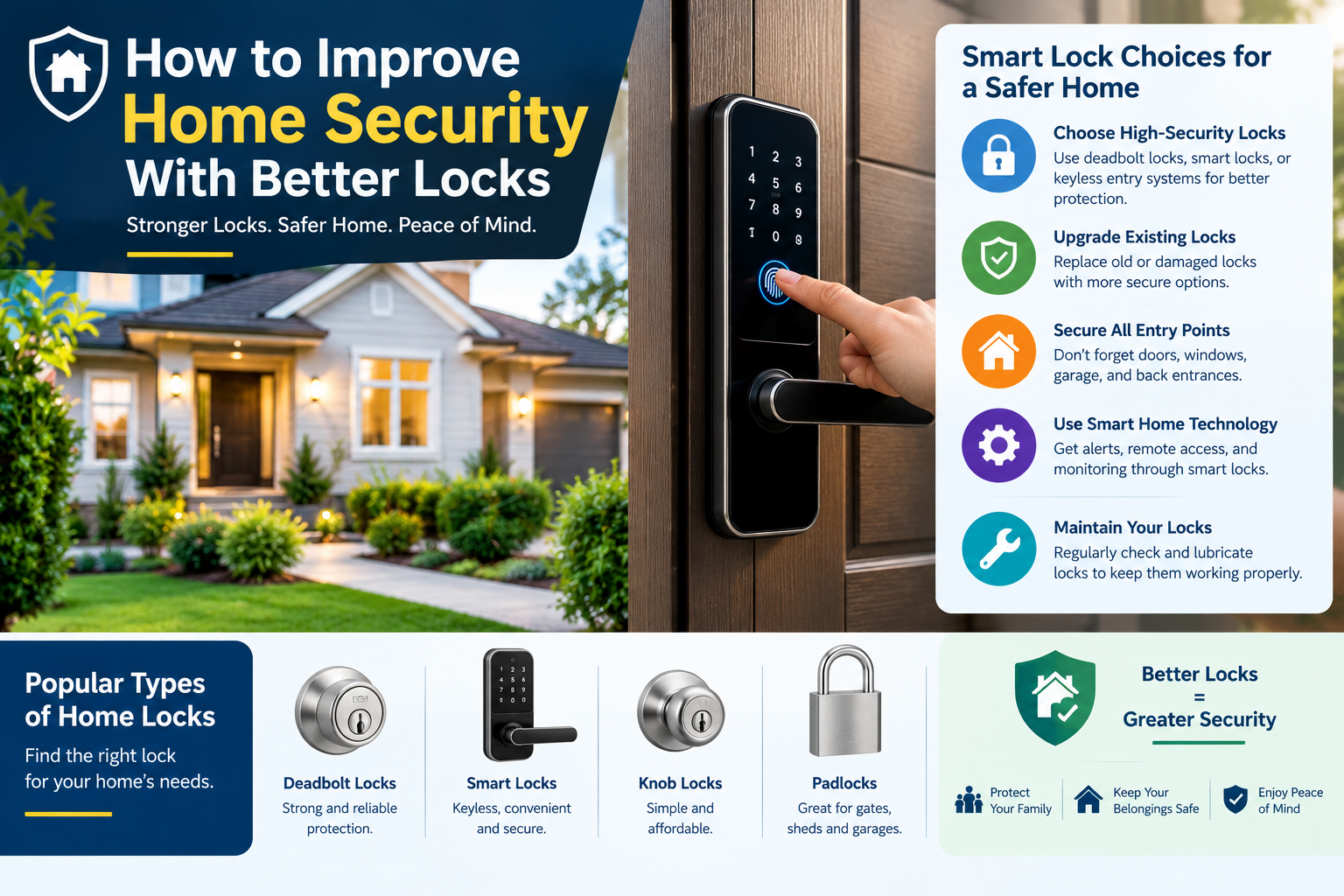
Your home’s locks are one of the first barriers against unauthorized entry. Even with security cameras, alarms, and outdoor lighting, weak or poorly installed locks can leave important entry points vulnerable. Learning how to improve home security with better locks can help strengthen your home’s overall security.
The right lock depends on the type of door, the strength of the door frame, the quality of the installation, and how the entrance is used. A quality deadbolt, reinforced door frame, properly secured strike plate, or well-managed smart lock can improve security when used correctly.
This guide explains practical ways to improve home security with better locks, including choosing deadbolts, reinforcing doors, improving key control, considering smart locks, and maintaining existing hardware.
Why Better Locks Matter for Home Security
A door lock is only one part of a complete home security system, but it plays an important role. A strong lock can help prevent unauthorized entry when combined with a solid door and secure frame.
Many homeowners focus on the lock itself and overlook the surrounding hardware. However, even a high-quality lock may provide limited protection if it is installed in a weak or damaged door frame.
Effective door security usually depends on several components working together:
- A strong exterior door
- A high-quality deadbolt or suitable locking system
- A secure door frame
- A properly installed strike plate
- Appropriate screws for the door and frame
- Controlled access to keys or entry codes
- Regular inspection and maintenance
Improving these areas can provide more protection than simply replacing an inexpensive lock with another basic lock.
Upgrade to a High-Quality Deadbolt
One of the most practical ways to improve home security is to install a quality deadbolt on exterior doors.
Unlike a spring-latch lock, a deadbolt is designed to remain extended until it is deliberately operated. This makes it an important security feature for many residential entry doors.
Choose the Right Deadbolt
When selecting a deadbolt, consider:
- Overall construction quality
- Resistance to common forms of forced entry
- Compatibility with your door
- Installation requirements
- Key-control features
- Suitability for the specific entrance
A single-cylinder deadbolt is commonly used on residential doors. It generally operates with a key from the outside and a thumb turn from inside.
Double-cylinder deadbolts require a key on both sides. They may provide different security characteristics, but they can also create safety concerns during an emergency because occupants need a key to unlock the door from inside. Always consider local building and fire-safety requirements before installing this type of lock.
Reinforce the Door Frame and Strike Plate
A better lock cannot fully secure a weak door frame.
The strike plate is the metal component attached to the door frame where the latch or deadbolt enters. A strong strike plate that is installed correctly can improve the connection between the lock and the frame.
Use Appropriate Screws
Short screws may provide limited engagement with the surrounding material. Depending on the construction of the door and frame, longer screws can help secure the hardware more firmly.
However, screw length alone does not guarantee better security. The screws must be suitable for the door frame and installed correctly.
If you are unsure about the construction of your door frame, consider having a qualified locksmith or professional installer inspect it.
Consider a Smart Lock
Smart locks are another option for homeowners who want convenient access control.
Depending on the model, a smart lock may allow you to lock and unlock a door using a keypad, smartphone, fingerprint reader, or another access method.
Benefits of Smart Locks
Depending on the product, smart locks may offer features such as:
- Keyless entry
- Temporary access codes
- Individual codes for different users
- Automatic locking
- Access activity records
- Remote control
- Integration with other smart-home devices
These features can be useful for families, rental properties, and homes where multiple people need regular access.
Security Considerations for Smart Locks
Smart locks add technology to your home’s physical security, so convenience should not replace good security practices.
Choose a reputable product, keep its software updated, protect associated accounts with strong passwords, and enable multi-factor authentication when available.
You should also understand what happens if the lock’s battery runs out or its electronic system becomes unavailable. A reliable backup entry method can help prevent unnecessary lockouts.
Improve Key Control
Traditional keys can create security concerns when too many copies are in circulation.
You may not know how many copies exist if previous occupants, contractors, tenants, or other people have had access to your home.
If you move into a new property, changing or rekeying the locks can help you regain control over who has access.
Rekey or Replace the Lock
Rekeying changes the internal configuration of a compatible lock so that an old key can no longer operate it. This can be useful when the existing hardware is in good condition but you want to eliminate access through previous keys.
Replacing the entire lock may be more appropriate when the existing hardware is damaged, outdated, poorly designed, or unsuitable for the door.
A professional locksmith can help determine whether rekeying or replacing the lock is the better option.
Secure Every Exterior Entry Point
Improving the front door while ignoring other entrances can leave your home vulnerable through another access point.
Review every exterior door, including:
- Front entrance
- Back door
- Side door
- Garage entry door
- Basement or secondary entrance
- Doors leading from an attached garage
Each entrance should have appropriate hardware and should close and lock properly.
Do Not Forget the Garage
An attached garage can provide another route into the home. The interior door connecting the garage to your living space should receive the same security attention as other important entrances.
Make sure the door closes properly and that its lock, hinges, frame, and surrounding hardware are in good condition.
Secure Sliding Doors and Secondary Entrances
Sliding glass doors require different security considerations from standard hinged doors.
Their locking mechanisms may be less substantial, depending on the design and condition of the door. You can improve security by making sure the existing lock works properly and that the door cannot be opened when locked.
Additional security devices may also be available for specific sliding-door designs.
Avoid improvised modifications that could interfere with emergency exits or damage the door. If you are unsure about the best solution, consult a qualified professional.
Inspect Your Locks Regularly
Even a high-quality lock can become less effective if it is damaged, loose, misaligned, or poorly maintained.
Check your locks periodically for signs such as:
- Difficulty turning the key
- Loose hardware
- A deadbolt that does not extend fully
- Misalignment between the door and frame
- Cracks around the strike plate
- A door that does not close properly
- Unusual resistance when locking or unlocking
These problems may indicate that the lock, door, or frame needs adjustment or repair.
A lock that frequently sticks should not simply be forced. Continued force can damage the mechanism or surrounding hardware.
Choose Locks Based on the Door
Not every lock is appropriate for every door.
Before purchasing a new lock, consider the door’s material, thickness, frame construction, and existing hardware. A lock designed for one type of residential door may not be suitable for another installation.
You should also consider how the door is used.
For example, a frequently used front entrance may benefit from a smart lock for convenient access, while a less frequently used secondary entrance may only need a reliable mechanical lock.
The goal is to match the security hardware to the needs of the specific entrance.
Combine Better Locks With Other Security Measures
Better locks are valuable, but they should not be your only security measure.
A stronger home security plan can combine physical security with other practical measures.
Consider adding:
- Exterior lighting: Good lighting can make entrances more visible at night.
- Door and window sensors: These can alert you when an entry point is opened.
- Security cameras: Cameras can help monitor activity around the property.
- Alarm systems: An alarm can provide another layer of protection.
- Secure windows: Ground-level and easily accessible windows should also be inspected.
- Clear landscaping: Keep entrances visible instead of hiding them behind dense vegetation.
This layered approach means that if one security measure fails, other measures can still provide protection.
Common Mistakes to Avoid When Improving Door Security
Some homeowners spend money on better locks but overlook basic installation and maintenance issues.
Common mistakes include:
- Installing a strong lock on a weak door
- Ignoring the door frame
- Leaving spare keys in obvious outdoor locations
- Sharing access codes unnecessarily
- Failing to change access codes when circumstances change
- Ignoring damaged or misaligned hardware
- Choosing a lock without checking door compatibility
- Relying entirely on smart-home technology
- Forgetting secondary exterior entrances
Avoiding these mistakes can help you get more value from your home security upgrades.
How to Choose the Best Locks for Your Home
There is no single lock that is ideal for every property. Start by evaluating your current security instead of immediately buying new hardware.
Ask yourself:
- Which doors provide exterior access?
- Are the current locks damaged or outdated?
- Is the door frame strong and properly secured?
- Who currently has keys or access codes?
- Do you need keyless entry?
- What happens if a smart lock loses power?
- Are all exterior doors equally secure?
- Do local building or fire-safety requirements affect your choice?
After identifying weaknesses, prioritize the entrances that need the most attention.
For many homeowners, upgrading a weak deadbolt and reinforcing the door frame can be a practical starting point. Others may benefit more from rekeying existing locks or adding controlled access through a smart lock.
When to Hire a Professional Locksmith
Some lock upgrades are straightforward, while others require specialized knowledge.
Consider professional assistance if:
- The door frame is damaged.
- The lock does not align correctly.
- You need several locks rekeyed.
- You are unsure which lock fits your door.
- You are installing a more complex access-control system.
- You have experienced repeated lock failures.
- You want an assessment of your home’s existing door security.
A qualified locksmith can inspect the complete door assembly rather than focusing only on the lock.
Frequently Asked Questions
1. What is the best type of lock for home security?
A high-quality deadbolt is a common choice for residential exterior doors. The best option depends on the door, frame, installation, and your access requirements.
2. Are smart locks safer than traditional locks?
Smart locks can provide useful security and access-control features, but they are not automatically safer than mechanical locks. Product quality, installation, account security, software updates, and backup access all matter.
3. Should I replace my locks when I move into a new home?
Changing or rekeying the locks can be a sensible way to prevent previous occupants or other people with old keys from retaining access. A locksmith can help determine the best option for your existing hardware.
4. Does a stronger lock make a door more secure?
A stronger lock can improve security, but the entire door assembly matters. A weak frame, damaged door, or poorly installed strike plate can reduce the effectiveness of an otherwise strong lock.
5. How often should I check my door locks?
Inspect your locks whenever you notice sticking, looseness, misalignment, or other problems. It is also useful to check all exterior doors periodically as part of your regular home maintenance routine.
Conclusion
Learning how to improve home security with better locks starts with understanding that a lock is only one part of a complete security system. A quality deadbolt, strong strike plate, secure door frame, controlled key access, and proper installation can work together to create a stronger entry point.
Smart locks can add convenience and access-control features, while traditional locks can provide dependable mechanical operation. Whichever option you choose, make sure it is compatible with your door and appropriate for your household’s needs.
Finally, inspect every exterior entrance rather than focusing only on the front door. When better locks are combined with secure doors, lighting, cameras, alarms, and responsible access practices, they become an important part of a stronger and more practical home security strategy.


Pingback: Gregg Home Improvements: Services, Costs & Tips
Pingback: How to Improve Piano Finger Speed and Dexterity at Home