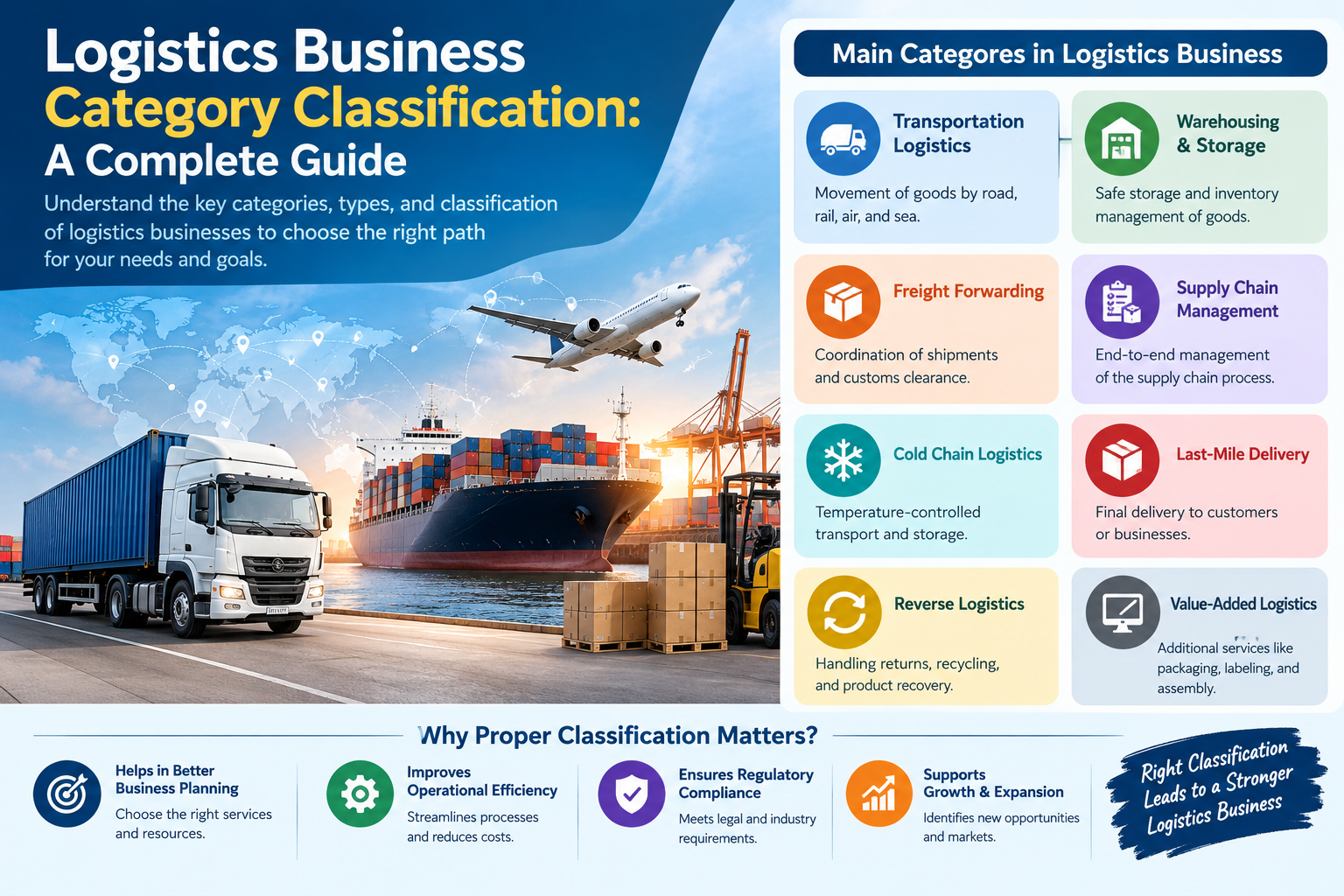
A logistics business can fall into several categories depending on the services it provides. Some companies transport goods, while others manage warehouses, arrange shipments, handle customs, or coordinate supply chain operations.
Understanding logistics business category classification helps business owners choose an appropriate industry category for registration, marketing, accounting, and business planning.
The logistics industry covers transportation, warehousing, freight management, distribution, fulfillment, and supply chain services. A company may operate in one area or provide several logistics services.
This guide explains the major logistics business categories, how they differ, and how to determine the most appropriate classification for a logistics company.
What Is Logistics Business Category Classification?
Logistics business category classification is the process of identifying a logistics company based on its primary business activity.
The appropriate classification generally depends on what the company mainly does. For example, a company that owns trucks and transports cargo may fall under freight transportation. A company that stores and manages products for other businesses may fall under warehousing and storage.
A logistics company can provide multiple services, but its primary category should generally reflect its main business activity.
Common logistics categories include:
- Freight transportation
- Warehousing and storage
- Freight forwarding
- Courier and delivery services
- Third-party logistics (3PL)
- Supply chain management
- Customs and trade logistics
- Distribution and fulfillment
- Specialized logistics
- Transportation support services
Main Categories of Logistics Businesses
1. Freight Transportation
Freight transportation is a major logistics business category. These companies move goods from one location to another using road, rail, air, or water transportation.
Road freight companies may operate trucks, vans, or other commercial vehicles. They can transport goods locally, nationally, or across borders.
Examples include:
- Trucking companies
- Container transport companies
- Bulk cargo transportation
- Refrigerated transportation
- Heavy-haul transportation
A company whose primary service is physically transporting cargo would generally fit into the freight transportation category.
2. Warehousing and Storage
Warehousing businesses provide facilities where companies can store products before they are sold or transported.
Modern warehouses often provide more than basic storage. They may also handle receiving, inventory management, packing, labeling, and dispatch.
Common warehousing services include:
- General storage
- Cold storage
- Distribution centers
- Inventory management
- Fulfillment storage
- Bonded warehousing
A company whose primary service is storing goods would generally fall under warehousing and storage rather than freight transportation.
3. Freight Forwarding
Freight forwarders arrange the movement of goods on behalf of customers. They may coordinate transportation between different carriers instead of operating all the vehicles themselves.
For example, a freight forwarder may arrange for a shipment to travel by truck to a port, by ship internationally, and then by truck to its final destination.
Freight forwarding services can include:
- Shipment planning
- Carrier selection
- Documentation
- Cargo coordination
- International shipping arrangements
- Delivery coordination
Freight forwarding is particularly important in international trade because shipments often involve multiple transportation methods and providers.
4. Courier and Delivery Services
Courier and delivery businesses specialize in moving packages, documents, parcels, and other items.
These companies may provide same-day, next-day, local, national, or international delivery services.
Examples include:
- Parcel delivery
- Document delivery
- E-commerce delivery
- Same-day delivery
- Last-mile delivery
- Express delivery
Last-mile delivery involves moving an order from a distribution center, warehouse, or local facility to the final customer.
5. Third-Party Logistics (3PL)
A third-party logistics company provides logistics services for another business. Instead of managing every logistics function internally, a company can outsource some or all of these operations to a 3PL provider.
A 3PL company may handle:
- Transportation
- Warehousing
- Order fulfillment
- Inventory management
- Packaging
- Distribution
- Returns management
For example, an online retailer may sell products while a 3PL provider stores inventory, prepares orders, and arranges deliveries.
The 3PL category is therefore broader than a traditional transportation business.
6. Supply Chain Management
Supply chain management businesses focus on coordinating the broader movement of products, materials, information, and related activities.
Logistics is an important part of supply chain management, but the two terms are not identical.
A supply chain management company may help businesses with:
- Supplier coordination
- Procurement planning
- Inventory planning
- Demand forecasting
- Distribution planning
- Transportation management
- Supply chain optimization
Some companies provide these services as consultants, while others use specialized technology to manage supply chain operations.
7. Distribution and Fulfillment
Distribution and fulfillment businesses help companies process and deliver customer orders.
A fulfillment provider may receive inventory, store products, process orders, pack shipments, and arrange delivery.
This category is especially relevant to e-commerce businesses.
For example, an online store can send its inventory to a fulfillment center. When a customer places an order, the fulfillment provider prepares the package and arranges its delivery.
Fulfillment businesses can therefore combine warehousing, order processing, packaging, and delivery coordination.
8. Customs and Trade Logistics
International shipments often require customs documentation and compliance with import and export requirements.
Businesses specializing in customs-related logistics may help importers and exporters prepare documents and coordinate customs procedures.
Services can include:
- Import documentation
- Export documentation
- Customs clearance
- Trade compliance support
- Shipment documentation
- Coordination with carriers and authorities
The legal classification of customs-related businesses can vary by jurisdiction. Companies should check the requirements that apply in their country.
9. Specialized Logistics
Some logistics companies focus on products that require special handling or transportation conditions.
Examples include:
- Temperature-controlled goods
- Perishable food
- Pharmaceuticals
- Oversized equipment
- Industrial machinery
- Fragile products
- Hazardous cargo
These businesses may require specialized vehicles, storage facilities, equipment, procedures, or regulatory compliance.
Specialized logistics can therefore represent a distinct service area within the broader logistics industry.
Logistics Business Classification by Transportation Mode
Another way to classify logistics companies is by the transportation method they use.
Road Logistics
Road logistics uses trucks, vans, and other commercial vehicles to transport cargo.
It is commonly used for domestic transportation, regional freight, and last-mile delivery.
Rail Logistics
Rail logistics involves transporting goods by railway. It can be suitable for moving large quantities of cargo over long distances.
Air Logistics
Air freight is used when speed is important. It is often used for time-sensitive, high-value, or international shipments.
Ocean Logistics
Ocean freight is widely used for international cargo, particularly large shipments and containerized goods.
Multimodal Logistics
Multimodal logistics combines two or more transportation methods. A shipment might travel by truck to a port, by ship internationally, and then by truck to its final destination.
Logistics Business Classification by Service Model
Logistics companies can also be classified according to how much of the supply chain they manage.
1PL
First-party logistics (1PL) generally refers to businesses managing their own transportation or logistics activities rather than outsourcing them to an external logistics provider.
2PL
Second-party logistics (2PL) typically involves a company providing a specific logistics service, such as transportation or warehousing.
3PL
Third-party logistics (3PL) providers manage one or more logistics activities for another company. Their services can include transportation, warehousing, fulfillment, and distribution.
4PL
Fourth-party logistics (4PL) providers generally take a broader management role. They may coordinate multiple logistics providers and manage larger parts of a client’s supply chain.
These terms describe different levels of logistics involvement rather than simple legal business categories. Their precise use can vary among industries and service providers.
How to Choose the Right Logistics Business Category
Choosing the right category should start with the company’s primary business activity.
Ask the following questions:
- Does the company mainly transport goods?
- Does it mainly store products?
- Does it arrange shipments for customers?
- Does it provide courier or last-mile delivery?
- Does it manage fulfillment and distribution?
- Does it manage several logistics functions for clients?
- Does it primarily provide supply chain consulting or technology?
- Does it specialize in international trade or customs services?
The answers can help identify the company’s main business category.
For example, a company that owns a fleet of trucks and earns most of its revenue from transporting cargo would generally be considered a freight transportation business.
In contrast, a company that stores products, processes orders, and prepares packages for e-commerce sellers would be more closely associated with warehousing and fulfillment.
Logistics vs. Transportation: Are They the Same Category?
Logistics and transportation are closely related, but they are not identical.
Transportation primarily focuses on moving goods from one location to another. Logistics covers a broader range of activities involved in planning, managing, storing, and moving goods.
For example, a trucking company may provide transportation services. A logistics provider may coordinate trucking, warehousing, inventory, packaging, and delivery.
Transportation is therefore an important part of the broader logistics industry, but not every logistics business is a transportation company.
Why Correct Business Classification Matters
Correct business classification can be important for several practical reasons.
Business Registration
Government agencies may require businesses to select an industry or activity category during registration. The selected category should accurately reflect the company’s operations.
Licensing and Compliance
Certain transportation, customs, warehousing, and specialized logistics activities may have specific licensing or regulatory requirements.
Insurance
The risks faced by a trucking company can differ significantly from those faced by a warehouse or freight forwarding company. Accurate classification can help businesses identify appropriate insurance requirements.
Marketing
A clear category helps potential customers understand what a logistics company actually offers.
For example, a business that describes itself as a 3PL fulfillment provider communicates a different service offering from a company that describes itself as a freight transportation carrier.
Business Planning
Classification can also help owners evaluate competitors, identify target customers, plan services, and understand where the company fits within the logistics industry.
Common Examples of Logistics Business Categories
| Business Activity | Likely Category |
|---|---|
| Operating trucks to move cargo | Freight transportation |
| Providing facilities to store inventory | Warehousing and storage |
| Arranging international shipments | Freight forwarding |
| Delivering parcels to customers | Courier and delivery |
| Managing storage, fulfillment, and shipping for clients | 3PL |
| Processing online orders and preparing packages | Fulfillment |
| Coordinating multiple logistics providers | 4PL or supply chain management |
| Helping businesses with customs processes | Customs and trade logistics |
| Transporting temperature-sensitive products | Specialized logistics |
The exact classification may depend on the company’s primary activity and the classification system used in a particular country.
Logistics Business Category Classification for Online Businesses
For websites, business directories, and online profiles, a logistics company should select the category that most closely describes its primary service.
For example:
- A trucking company can use Freight Transportation.
- A storage company can use Warehousing and Storage.
- A parcel company can use Courier and Delivery Services.
- A shipment coordination company can use Freight Forwarding.
- An outsourced logistics provider can use Third-Party Logistics (3PL).
- An e-commerce order processing company can use Fulfillment Services.
If a platform allows secondary categories, businesses can include additional services without making the primary category unclear.
Frequently Asked Questions
What is the main category of a logistics business?
The main category depends on the company’s primary activity. Common categories include freight transportation, warehousing, freight forwarding, courier services, fulfillment, and third-party logistics.
Is logistics considered a transportation business?
Logistics includes transportation, but the terms are not identical. Transportation focuses on moving goods, while logistics can include transportation, storage, inventory management, fulfillment, and coordination.
What category is a freight forwarding company?
A freight forwarding company generally falls under freight forwarding or logistics services because it arranges and coordinates shipments for customers.
What category is a 3PL company?
A 3PL company generally falls under third-party logistics or logistics services. Depending on its operations, it may also provide warehousing, transportation, fulfillment, or distribution services.
Can one logistics company have multiple categories?
Yes. A logistics company can provide several services. However, its primary category should generally represent the activity that best describes its main business.
Conclusion
Logistics business category classification depends primarily on what a company does and which service represents its main business activity. Freight transportation, warehousing, freight forwarding, courier delivery, fulfillment, 3PL, supply chain management, and specialized logistics are among the major categories.
Choosing an accurate category helps customers, business directories, regulators, and other organizations understand the company’s services. It can also support clearer marketing, business planning, and compliance decisions.
The most practical approach is straightforward: identify the company’s primary service first, then select the category that most accurately describes that activity. Businesses should also check the specific classification and regulatory requirements that apply to their country and industry.