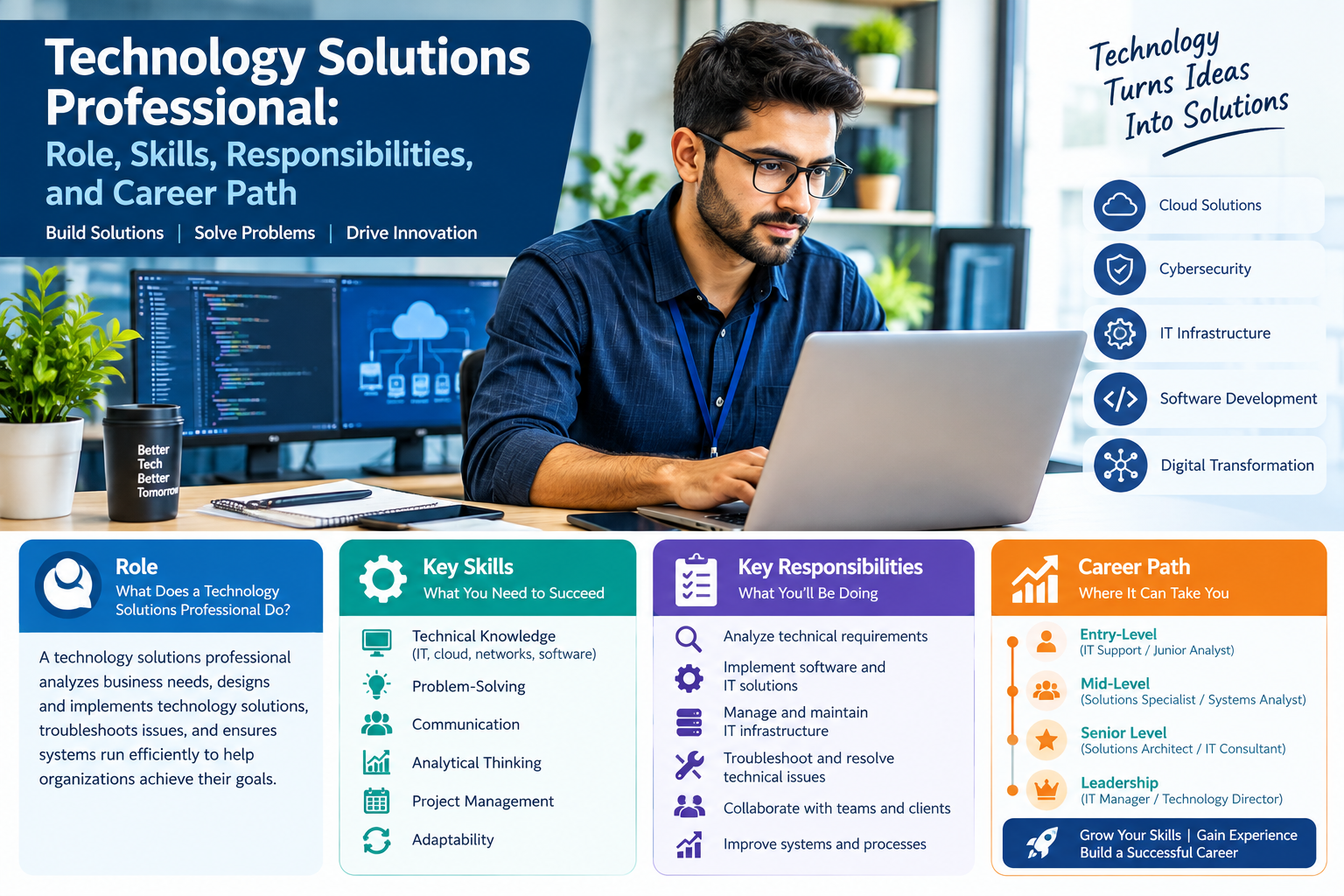
Businesses today rely on technology to improve productivity, manage information, serve customers, and remain competitive. A technology solutions professional helps organizations select, implement, manage, and improve technology that supports these goals.
This role can involve many responsibilities, from analyzing business problems and recommending software to supporting cloud systems, cybersecurity, automation, and digital transformation projects. Unlike positions focused only on technical tasks, a technology solutions professional often works between business and technology teams.
Understanding this career can help students, professionals, and businesses determine what the role involves, which skills are required, and what career opportunities are available.
What Is a Technology Solutions Professional?
A technology solutions professional uses technology to solve practical business and organizational problems.
The exact job title varies between companies. Related positions may include:
- Technology solutions consultant
- Solutions consultant
- Solutions architect
- Technology consultant
- IT solutions specialist
- Business technology consultant
- Digital solutions specialist
- Technology analyst
Although responsibilities differ, the basic objective remains similar: understand a problem, identify the requirements, and develop or recommend an appropriate technology solution.
For example, a company may struggle with slow customer support because employees manually process requests. A technology solutions professional could analyze the workflow and recommend a customer relationship management system, automation platform, or integrated support solution.
They may also help implement the solution and evaluate whether it meets the organization’s objectives.
What Does a Technology Solutions Professional Do?
Responsibilities vary by company, industry, and specialization. However, several activities are common across the profession.
1. Understand Business Problems
Technology should address a genuine business need rather than be adopted simply because it is new.
A technology solutions professional works with managers, employees, and other stakeholders to understand current problems, business objectives, limitations, and desired outcomes.
For example, an organization may want to:
- Reduce manual work
- Improve customer service
- Protect sensitive information
- Lower operating costs
- Improve data management
- Move systems to the cloud
- Automate repetitive processes
- Improve collaboration between teams
Understanding the underlying problem is often more important than selecting a particular technology.
2. Evaluate Technology Options
After identifying the requirements, the professional researches and compares potential solutions.
This may involve evaluating software platforms, cloud services, databases, cybersecurity tools, automation systems, or enterprise applications.
Important evaluation criteria can include:
- Cost
- Scalability
- Security
- Compatibility
- Ease of use
- Integration capabilities
- Maintenance requirements
- Implementation time
An effective solution should fit both the organization’s technical environment and its business needs.
3. Design Technology Solutions
Some technology solutions professionals help design the technical structure of a proposed solution.
For example, they may determine how different applications should communicate or how information should move between systems.
Depending on the position, their work may involve:
- System architecture
- Cloud infrastructure
- APIs
- Databases
- Network systems
- Software platforms
- Security controls
- Data integration
The level of technical involvement varies considerably between roles.
4. Implement and Integrate Solutions
Selecting a technology is only one part of the process.
A solution may need to be configured, customized, tested, and integrated with existing systems. A technology solutions professional may coordinate these activities with developers, IT teams, vendors, and business departments.
They may also identify implementation problems and recommend adjustments before the system becomes fully operational.
5. Train Users and Support Adoption
Even an effective technology solution can fail to deliver its potential if employees do not understand how to use it.
Technology solutions professionals may create documentation, conduct training sessions, answer user questions, and help teams adapt to new systems.
This requires strong communication skills because users often have different levels of technical knowledge.
Key Skills for a Technology Solutions Professional
Successful professionals typically combine technical expertise with business and communication skills.
Technical Skills
The technical skills required depend on the individual’s specialization. Common areas include:
- Cloud computing
- Databases
- Networking
- Cybersecurity
- Software development concepts
- APIs and system integration
- Data analysis
- Automation
- Enterprise software
- IT infrastructure
A technology solutions professional does not necessarily need to be an expert in every technology. However, they should understand how major technologies work and recognize when different types of solutions are appropriate.
Analytical Thinking
Problem-solving is one of the most important skills in this career.
Professionals must break complex problems into smaller parts, identify their causes, compare possible solutions, and evaluate potential outcomes.
Strong analytical thinking helps organizations avoid investing in technology that does not address their actual needs.
Communication Skills
Technology solutions professionals regularly communicate with both technical and non-technical audiences.
They may need to explain a complex system to a business manager in simple language or translate business requirements into technical requirements for an IT team.
Clear communication can therefore be just as important as technical knowledge.
Project Management
Technology projects often involve deadlines, budgets, multiple teams, and competing priorities.
Basic project management skills help professionals organize tasks, monitor progress, manage risks, and communicate changes to stakeholders.
Business Knowledge
A strong technology professional understands that technology is a tool for achieving business objectives.
Knowledge of areas such as finance, operations, sales, customer service, and marketing can help professionals make more practical technology recommendations.
Technology Solutions Professional vs. IT Professional
The two roles can overlap, but they are not always identical.
Traditional IT roles often focus on maintaining and supporting an organization’s technology environment. This can include networks, devices, servers, user accounts, and technical support.
A technology solutions professional may have a broader focus. Their work often involves determining how technology can improve a business process or solve a specific organizational problem.
For example:
IT professional:
Ensures employees can securely access the company’s systems.
Technology solutions professional:
Analyzes how employees work and recommends technology that can improve the overall workflow.
There can be considerable overlap between these responsibilities, particularly in smaller organizations.
Industries That Hire Technology Solutions Professionals
Technology solutions professionals can work in almost any industry because organizations across the economy rely on digital systems.
Common industries include:
- Banking and financial services
- Healthcare
- Retail
- Manufacturing
- Telecommunications
- Education
- Government
- Logistics
- E-commerce
- Professional services
- Software and technology
The technology used may differ from one industry to another, but the underlying problem-solving process remains similar.
Common Career Paths
There is no single career path for becoming a technology solutions professional.
Some people begin in technical positions and gradually move into consulting or solution design. Others start in business or project roles and develop strong technical expertise over time.
A possible career progression is:
Junior IT or technology role → Technology specialist → Solutions consultant → Senior solutions professional → Solutions architect or technology manager
Other career paths may lead to specialized areas such as cloud architecture, cybersecurity consulting, data solutions, or enterprise software.
Education and Certifications
A bachelor’s degree in computer science, information technology, software engineering, business information systems, or a related field can provide a strong foundation.
However, formal education is only one part of career development. Practical skills and professional experience are also important.
Depending on the desired career direction, professionals may benefit from certifications related to:
- Cloud computing
- Cybersecurity
- Networking
- Project management
- Enterprise platforms
- Data analytics
Certifications can demonstrate knowledge, but they do not replace practical experience. Building projects, working with real systems, and understanding how organizations use technology can be equally valuable.
How to Become a Technology Solutions Professional
If you want to enter this field, a structured approach can help you build the right combination of technical and business skills.
Step 1: Build a Technical Foundation
Learn the fundamentals of computers, networks, databases, software, cloud computing, and cybersecurity.
You do not need to master everything at once. Start with the technologies most relevant to your intended career path.
Step 2: Learn Business Problem-Solving
Develop an understanding of how organizations operate.
Learn about processes such as sales, customer service, finance, inventory management, and employee collaboration. This knowledge will help you connect technology with real business requirements.
Step 3: Develop Communication Skills
Practice explaining technical concepts in simple, clear language.
Learn how to write requirements, document processes, create presentations, and communicate recommendations to different audiences.
Step 4: Build Practical Projects
Create projects that demonstrate your ability to solve problems with technology.
For example, you could design a simple inventory management system, automate a repetitive business task, or create a dashboard for analyzing business data.
Practical projects give employers evidence of your problem-solving and technical abilities.
Step 5: Gain Professional Experience
Internships, entry-level IT positions, technical support roles, software jobs, and business technology positions can all provide valuable experience.
Over time, seek opportunities to work on projects involving business requirements, technology decisions, and collaboration with stakeholders.
Why Businesses Need Technology Solutions Professionals
Technology is now closely connected to everyday business operations.
Organizations may rely on dozens of applications, cloud services, databases, communication platforms, and automated processes. Without proper planning, these systems can become difficult to manage and integrate.
A technology solutions professional helps organizations make informed technology decisions.
Their work may contribute to:
- Improving business processes
- Connecting different systems
- Reducing unnecessary manual work
- Supporting digital transformation
- Improving technology adoption
- Identifying technical risks
- Helping teams use data effectively
- Aligning technology investments with business objectives
The goal is not simply to introduce more technology. It is to use the right technology for the right problem.
Challenges in the Technology Solutions Profession
The profession also comes with challenges.
Technology changes quickly, so professionals need to continue learning throughout their careers. A solution that works well today may need to evolve as business requirements and technology change.
Professionals may also face competing priorities. One department may prioritize lower costs, while another may want advanced features. Security teams may have additional requirements that affect implementation.
Managing these competing demands requires technical knowledge, communication skills, patience, and sound judgment.
The Future of Technology Solutions Careers
Artificial intelligence, cloud computing, automation, cybersecurity, data analytics, and connected systems continue to influence how organizations operate.
These technologies are also changing the responsibilities of technology professionals.
Rather than focusing only on maintaining existing systems, many professionals increasingly help organizations determine how emerging technologies can be used effectively and responsibly.
Artificial intelligence is a good example. A technology solutions professional may help a company identify appropriate AI use cases, evaluate available tools, consider data and security requirements, and integrate an AI system into existing workflows.
The ability to understand both technology and business needs will remain valuable as organizations adopt new digital tools.
Frequently Asked Questions
What is a technology solutions professional?
A technology solutions professional helps organizations use technology to solve business and operational problems. Their responsibilities can include analysis, technology selection, solution design, implementation, integration, and user support.
What skills does a technology solutions professional need?
Important skills include technical knowledge, analytical thinking, communication, project management, problem-solving, and business understanding. The specific technical skills depend on the individual’s area of specialization.
Do you need a degree to become a technology solutions professional?
A degree can provide a strong foundation, particularly in IT, computer science, software engineering, or information systems. However, practical experience, technical skills, projects, and relevant certifications can also contribute significantly to career development.
Is a technology solutions professional the same as a software developer?
Not necessarily. A software developer primarily focuses on creating and maintaining software. A technology solutions professional may have a broader role involving business analysis, technology selection, solution design, implementation, and coordination.
Is this a good career for someone who likes both business and technology?
Yes. The profession can be suitable for people who enjoy technology while also having an interest in communication, business strategy, analysis, and problem-solving. Many positions require professionals to connect technical teams with business stakeholders.
Conclusion
A technology solutions professional helps organizations turn technology into practical business value. The profession combines technical knowledge with problem-solving, communication, and business understanding.
Strong professionals do not simply recommend the newest technology. They first understand the problem, evaluate realistic options, consider costs and risks, and help organizations implement solutions that fit their actual needs.
For people interested in both technology and business, this career can provide opportunities in consulting, solution architecture, cloud computing, cybersecurity, data, enterprise technology, and digital transformation.



Pingback: How to Integrate Technology With Traditional Farming
Pingback: Joint Range of Motion Assessment Technology: 7 Key Benefits