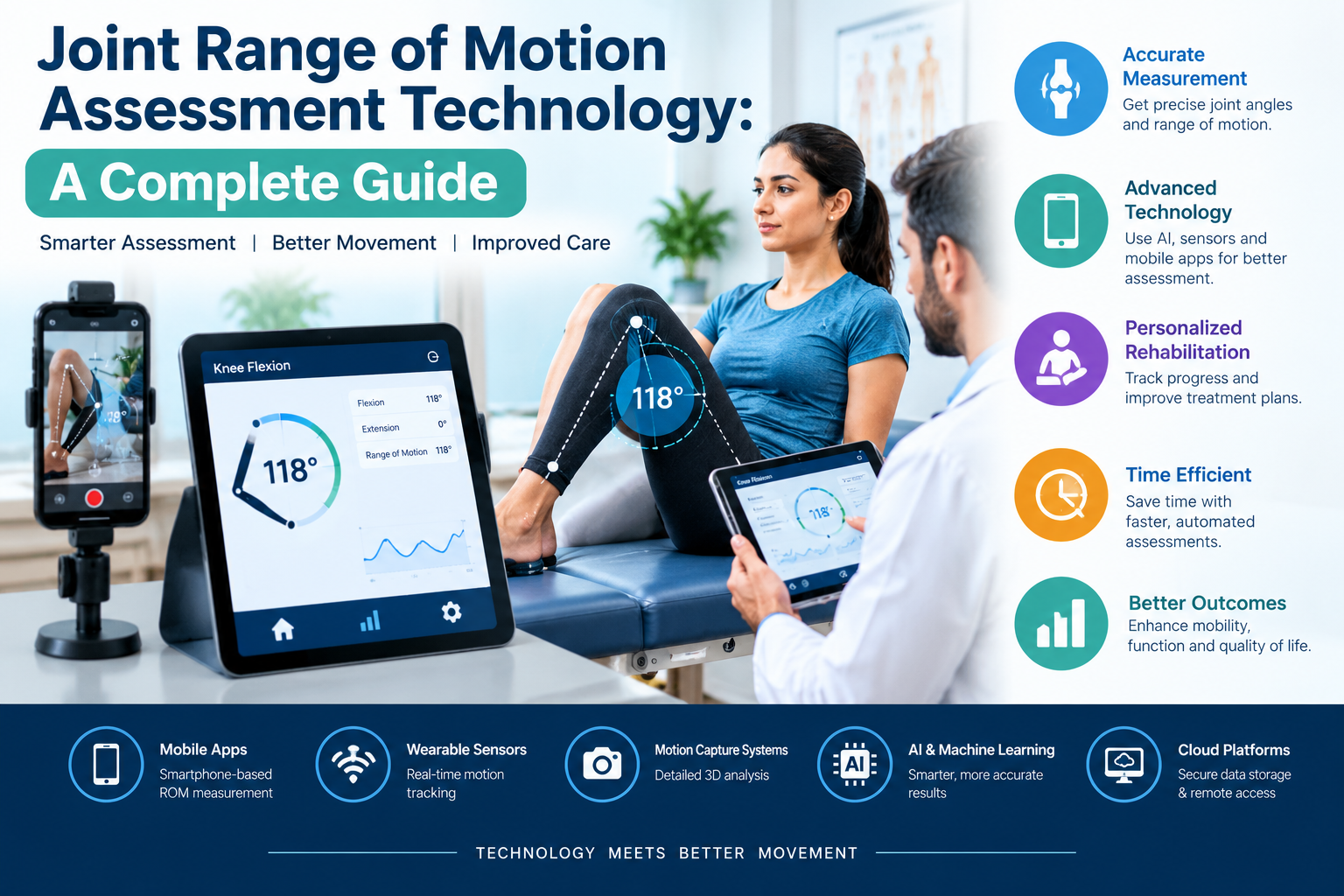
Joint range of motion assessment technology is changing how healthcare professionals, physiotherapists, rehabilitation specialists, and sports trainers evaluate human movement. By using modern measurement tools, professionals can examine how far a joint moves, identify movement restrictions, and monitor changes during rehabilitation.
Joint mobility plays an important role in everyday activities. Simple movements such as walking, reaching overhead, bending the knee, or turning the neck depend on joints moving through an appropriate range. When movement becomes restricted, it can affect comfort, physical performance, and independence.
Traditionally, healthcare professionals have used manual techniques and instruments such as goniometers to measure joint movement. Today, digital devices, wearable sensors, motion-tracking systems, and specialized assessment software offer additional ways to collect and analyze movement data.
Understanding these technologies is important because accurate movement assessment can help professionals make informed decisions about rehabilitation and physical performance. However, every measurement method has advantages and limitations, and selecting the right technology depends on the patient’s needs and the assessment environment.
What Is Joint Range of Motion Assessment?
Joint range of motion (ROM) refers to the amount of movement available at a particular joint. It is generally measured in degrees and describes how far a joint can move in a specific direction.
For example, bending the elbow involves flexion, while straightening it involves extension. Similarly, raising an arm away from the body involves shoulder abduction.
A joint range of motion assessment measures these movements to understand the mobility and functional condition of a joint.
Healthcare professionals commonly perform ROM assessments to:
- Identify restricted joint movement.
- Evaluate mobility after an injury.
- Monitor progress during physical therapy.
- Compare movement between the left and right sides.
- Assess recovery following surgery.
- Support rehabilitation planning.
- Track changes in physical function.
ROM measurements are useful, but they should not be interpreted in isolation. Pain, muscle strength, swelling, joint stability, and the patient’s overall condition can also influence movement.
How Joint Range of Motion Assessment Technology Works
Modern ROM assessment technology uses different methods to measure joint movement. Some devices measure angles directly, while others track body movement using cameras or electronic sensors.
The basic assessment process usually involves three stages.
1. Movement Measurement
The professional identifies the joint and the movement that needs to be assessed. The patient then performs the required movement, either independently or with assistance.
A measurement device records the angle or movement pattern.
2. Data Collection
Depending on the technology, measurements may be collected through manual instrument readings, digital sensors, motion-tracking cameras, or specialized applications.
3. Analysis and Progress Monitoring
The recorded information can be reviewed to identify movement restrictions and compare measurements over time.
For example, a physiotherapist may measure a patient’s knee flexion during the first rehabilitation appointment and repeat the assessment during later visits. Comparing these results can help evaluate changes in mobility.
It is important to use consistent positioning and measurement techniques because differences in assessment methods can affect the results.
Types of Joint Range of Motion Assessment Technology
Different technologies are available for measuring joint movement. Each method offers specific advantages depending on the type of joint, clinical environment, and level of measurement detail required.
1. Digital Goniometers
Digital goniometers are electronic devices designed to measure joint angles. They perform a similar function to traditional goniometers but display measurements digitally.
A healthcare professional positions the instrument along the relevant body segments and records the movement angle.
Common applications include:
- Measuring knee flexion and extension.
- Assessing elbow mobility.
- Evaluating shoulder movement.
- Monitoring rehabilitation progress.
A digital device can make readings easier to record, although its reliability depends on correct positioning and the measurement procedure.
2. Smartphone-Based Assessment Applications
Smartphones have introduced another option for joint movement measurement.
Modern phones contain sensors such as accelerometers and gyroscopes. These components can detect changes in orientation and movement.
Specialized applications use this information to estimate joint angles. Some applications also use photographs or video recordings to analyze body positioning.
For example, a physiotherapist may use a smartphone application to assess shoulder movement during an outpatient appointment.
However, not every application provides clinically validated measurements. Professionals should consider the application’s accuracy, calibration requirements, and suitability for the specific joint being assessed.
3. Wearable Motion Sensors
Wearable sensors are small electronic devices that can be attached to different parts of the body.
They commonly use inertial measurement units (IMUs), which combine accelerometers and gyroscopes and may also include magnetometers.
These sensors collect movement information while a person performs physical activities.
For example, sensors attached to the upper arm and forearm can help estimate elbow movement during rehabilitation exercises.
Their accuracy depends on sensor placement, calibration, and the complexity of the movement being measured.
4. Camera-Based Motion Analysis
Camera-based motion analysis uses photographs or video recordings to examine body movement.
Some systems use two-dimensional video, while advanced platforms use multiple cameras to create three-dimensional movement models.
These systems can help professionals examine movement patterns that may be difficult to evaluate through a single angle measurement.
For example, a sports rehabilitation specialist may analyze how an athlete moves the knee during walking or running.
Camera-based systems can provide detailed information, but lighting, camera positioning, clothing, and body visibility can affect measurement quality.
Why Accurate Joint Range of Motion Measurements Matter
Accurate measurements provide useful information about joint mobility and help healthcare professionals evaluate changes during treatment.
Rehabilitation Progress Monitoring
Patients recovering from injuries or surgery may experience restricted movement.
Regular ROM assessments allow physiotherapists to compare measurements across appointments and evaluate whether mobility is changing.
For example, someone recovering from knee surgery may initially struggle to bend the knee. Repeated measurements can help document improvements during rehabilitation.
Treatment Planning
ROM findings can help professionals identify movement limitations and select appropriate rehabilitation activities.
A patient with restricted shoulder movement may require a different rehabilitation approach from someone experiencing limited ankle mobility.
Assessment results should be considered alongside pain levels, strength, medical history, and functional limitations.
Sports Performance and Injury Rehabilitation
Athletes depend on joint mobility to perform many physical activities.
Sports professionals can use movement assessments to identify restrictions and monitor mobility during rehabilitation.
For example, an athlete recovering from a shoulder injury may undergo repeated assessments to monitor movement before gradually returning to sport.
However, ROM measurements alone cannot establish whether an athlete is ready to return to competition.
Benefits of Modern ROM Assessment Technology
Modern measurement tools offer several practical benefits when used correctly.
Digital record keeping: Some systems allow professionals to save measurements electronically, making it easier to compare results across appointments.
Consistent monitoring: Standardized digital measurements can help reduce certain sources of recording variation.
Movement visualization: Camera-based systems can provide visual information about movement patterns.
Remote assessment opportunities: Smartphone applications and connected devices may support selected telehealth rehabilitation activities.
Improved documentation: Electronic records can help healthcare professionals organize patient measurements and communicate progress.
Challenges and Limitations of Joint Assessment Technology
Although modern technology offers useful measurement options, it also introduces challenges that professionals should understand.
Measurement Accuracy
Different devices may produce slightly different results. Accuracy can depend on sensor quality, calibration, body positioning, and measurement technique.
A device should not be considered reliable simply because it provides a digital reading.
Equipment Costs
Advanced motion capture systems can require specialized cameras, software, and technical support.
Smaller clinics may find digital goniometers or suitable smartphone applications more practical.
Professional Training
Healthcare professionals need appropriate training to position devices, follow assessment protocols, and interpret measurements.
Incorrect sensor placement or inconsistent positioning can affect the results.
Data Privacy
Digital assessment systems may collect sensitive patient information, photographs, or video recordings.
Healthcare providers should use secure systems, obtain appropriate consent, and follow applicable privacy requirements.
Not a Replacement for Clinical Judgment
A ROM measurement cannot explain every reason behind restricted movement.
Pain, swelling, muscle weakness, joint conditions, and other factors may influence a patient’s performance.
Technology should support professional assessment rather than replace clinical judgment.
How to Choose the Right Joint Range of Motion Assessment Technology
Selecting an appropriate assessment tool depends on the purpose of the measurement.
A small physiotherapy clinic may need an affordable and portable device for routine assessments. A research laboratory may require advanced motion capture technology to study complex movement patterns.
Before selecting equipment, consider the following factors:
- Measurement accuracy: Look for published validation and reliability evidence for the specific device and joint.
- Ease of use: Consider whether healthcare professionals can operate the device without complicated procedures.
- Compatibility: Check whether measurements can be exported to existing patient record systems.
- Portability: Determine whether the equipment is suitable for clinic visits, hospitals, or home assessments.
- Cost: Consider the initial purchase price, software subscriptions, maintenance, and training.
- Data security: Ensure patient information is handled appropriately.
The most sophisticated equipment is not necessarily required for every clinical situation. The right choice is the technology that provides useful, dependable measurements for the intended purpose.
The Future of Joint Range of Motion Assessment Technology
Joint assessment technology continues to develop as artificial intelligence, wearable electronics, and computer vision become more widely used.
One important area of development is automated movement analysis.
AI-supported systems may help identify movement patterns, process video recordings, and organize assessment results. This could make it easier for professionals to compare movement across multiple sessions.
Wearable sensors may also support movement monitoring outside traditional clinical environments. For example, a patient could perform selected rehabilitation exercises at home while a connected device records movement information for later review.
However, these developments still require appropriate validation, particularly when measurements are used to guide clinical decisions.
Future systems will need to balance accuracy, affordability, ease of use, and patient privacy.
Frequently Asked Questions (FAQs)
1. What is joint range of motion assessment technology?
It refers to tools and digital systems used to measure how far a joint can move. Examples include digital goniometers, smartphone applications, wearable sensors, and camera-based motion analysis systems.
2. What is the purpose of a ROM assessment?
A ROM assessment helps healthcare professionals evaluate joint mobility, identify movement restrictions, and monitor changes during rehabilitation or physical therapy.
3. Which device is commonly used to measure joint range of motion?
A universal goniometer is a commonly used clinical instrument. Digital goniometers and other electronic measurement systems provide additional options.
4. Can smartphones measure joint range of motion?
Yes. Certain smartphone applications use built-in sensors, photographs, or video analysis to estimate joint angles. Their suitability depends on validation, calibration, and the joint being assessed.
5. Are wearable sensors useful for joint assessment?
Wearable sensors can measure movement and estimate joint angles during different activities. Their accuracy depends on sensor placement, calibration, device design, and movement complexity.
6. Can joint range of motion technology support remote physiotherapy?
Yes. Selected smartphone applications and wearable devices can help collect movement information during home-based rehabilitation. However, remote measurements do not replace a complete clinical examination when one is required.
7. Is digital ROM assessment more accurate than manual measurement?
Not necessarily in every situation. Different digital methods can provide measurements comparable to traditional goniometry, but accuracy varies between devices, joints, and assessment procedures.
8. Can AI improve joint range of motion assessment?
AI may help analyze movement recordings, recognize movement patterns, and organize assessment data. Its clinical usefulness depends on the accuracy and validation of the system.
Conclusion
Joint range of motion assessment technology has become an important part of modern rehabilitation and movement analysis. From traditional goniometers to wearable sensors and camera-based systems, these tools provide different ways to measure and monitor joint mobility.
Digital assessment methods can improve documentation, support progress monitoring, and provide additional information about human movement. However, accurate results still depend on proper technique, suitable equipment, and professional interpretation.
As artificial intelligence and wearable technology continue to develop, joint movement assessment may become more accessible in clinics, research facilities, and selected home rehabilitation environments.
The most important consideration is choosing a measurement method that meets the patient’s needs and provides dependable information. When combined with professional clinical judgment, modern assessment technology can support more informed rehabilitation planning and better movement monitoring.