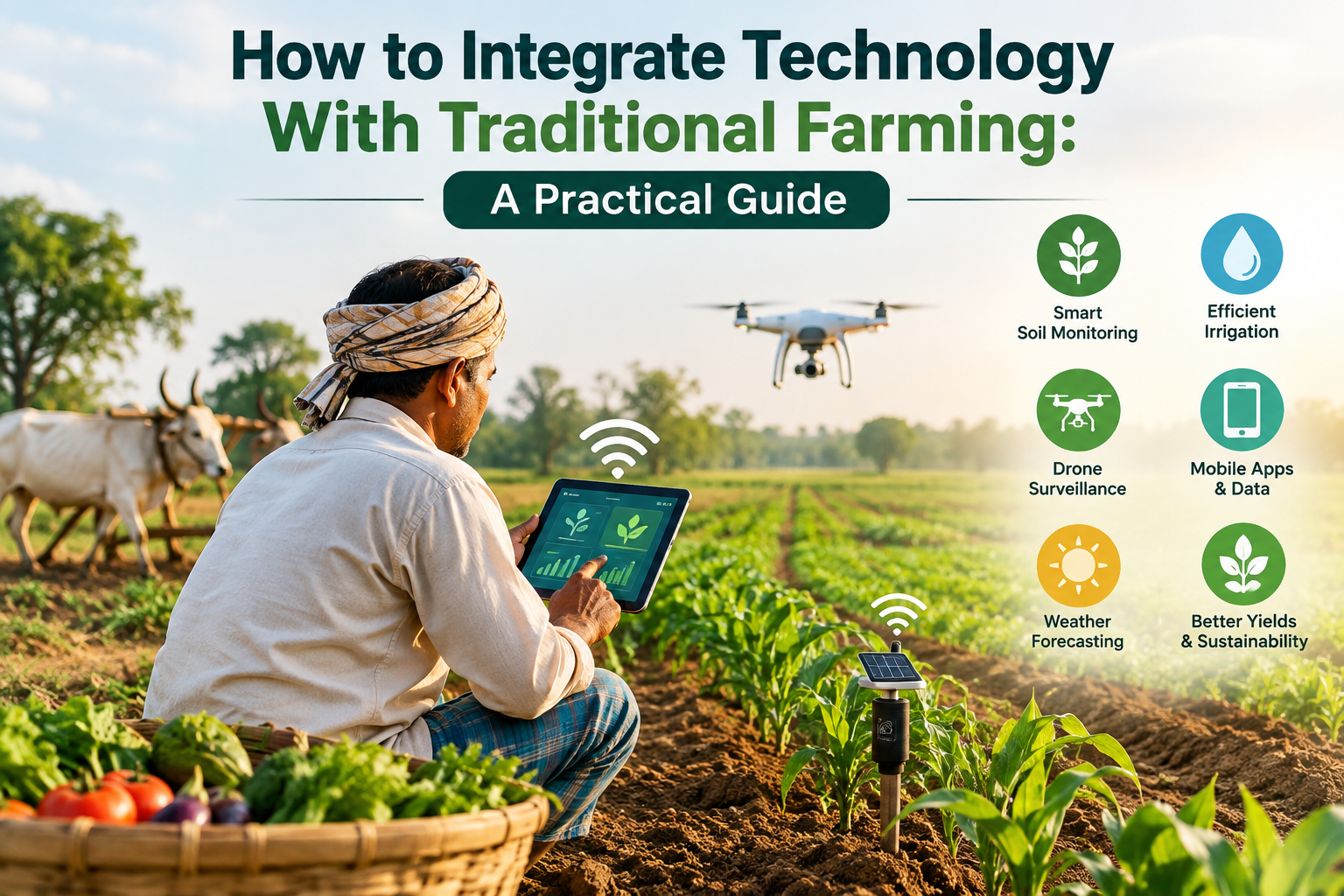
Traditional farming has supported communities for thousands of years, but modern technology is changing how farmers manage crops, soil, water, livestock, and agricultural resources. Farmers do not necessarily need to replace traditional farming methods with expensive machines or complicated systems. Instead, they can combine existing farming knowledge with simple and useful technologies.
If you are wondering how to integrate technology with traditional farming, the answer is to introduce technology gradually where it can solve a real farming problem. Tools such as mobile applications, weather information, soil sensors, GPS, irrigation systems, drones, and digital record-keeping can make traditional farming more efficient while preserving valuable agricultural practices.
In this guide, we will explore practical ways to combine technology with traditional farming and explain how farmers can start with affordable solutions.
What Is Traditional Farming?
Traditional farming refers to agricultural practices that have been passed from one generation to another. These practices often depend on local knowledge, seasonal patterns, experience, natural resources, and manual labor.
Traditional farmers may know the best time to plant a particular crop, understand local soil conditions, recognize common pests, and use traditional methods for irrigation and crop management.
This knowledge remains valuable. However, farmers can face challenges such as unpredictable weather, water shortages, increasing input costs, pests, and changing market conditions.
Technology can help address these challenges without completely replacing traditional knowledge.
How to Integrate Technology With Traditional Farming
The best approach is not to introduce every available technology at once. Farmers should identify their biggest problems and then choose technology that provides a practical solution.
Here are some of the most useful ways to integrate technology with traditional farming.
1. Use Mobile Phones for Farm Management
A smartphone can become one of the simplest technological tools on a farm.
Farmers can use mobile applications to check weather forecasts, record farming activities, monitor crop prices, communicate with agricultural experts, and maintain financial records.
For example, instead of relying only on traditional signs of changing weather, farmers can check reliable weather forecasts before deciding when to irrigate, spray crops, or harvest.
Farmers can also take photographs of crops and share them with agricultural specialists when they notice unusual symptoms.
The important advantage is that farmers can continue using their traditional knowledge while using mobile technology as an additional source of information.
2. Combine Traditional Knowledge With Weather Technology
Weather plays an important role in farming. Traditional farmers often understand local weather patterns through years of experience, but weather conditions can become difficult to predict.
Weather applications and digital forecasting services can provide information about temperature, rainfall, wind, and other conditions.
For example, if a farmer plans to apply a crop treatment, checking the weather forecast first may help avoid applying it immediately before heavy rainfall.
The best approach is to compare digital weather information with local experience rather than completely ignoring traditional knowledge.
3. Introduce Soil Testing and Sensors
Healthy soil is essential for productive farming. Traditionally, farmers may judge soil quality by observing its appearance, crop performance, and previous experience.
Modern soil testing can provide additional information about nutrients and soil conditions.
More advanced farms can use soil sensors to monitor factors such as moisture. This information can help farmers decide when irrigation may be necessary.
A simple moisture sensor can be particularly useful where water is limited. Instead of watering crops according to a fixed routine, farmers can use soil moisture information alongside their experience.
This creates a combination of traditional farming knowledge and data-based decision-making.
4. Improve Irrigation With Technology
Water management is one of the most important areas where technology can support traditional farming.
Traditional irrigation methods can still be useful, but modern systems can help deliver water more efficiently.
Drip irrigation, automated irrigation controllers, timers, and soil-moisture sensors are examples of technologies that can be integrated into existing farms.
A farmer does not always need a fully automated irrigation system. Even a simple timer or moisture sensor can provide useful information.
The goal is to supply crops with an appropriate amount of water while reducing unnecessary water use.
5. Use GPS and Digital Mapping
GPS technology can help farmers understand the size and location of different areas of their land.
Digital maps can be used to divide fields into sections, record crop locations, and plan agricultural activities.
For larger farms, GPS-based agricultural equipment can support more accurate field operations.
However, small farmers can also benefit from simple mapping applications on smartphones.
For example, a farmer can create digital records showing which section of land contains wheat, rice, vegetables, or another crop. This information can make future planning easier.
6. Use Drones for Crop Monitoring
Drones are another example of technology that can support traditional farming.
A drone equipped with a suitable camera can provide an aerial view of agricultural fields. This can help farmers identify areas that appear different from surrounding crops.
For example, a section of a field may show signs of poor growth, water stress, or pest problems.
Instead of physically walking across a large field to inspect every area, farmers can use aerial images to identify areas that may require closer examination.
Drones can be expensive, so they may not be suitable for every farmer. In some regions, farmers may benefit from agricultural service providers who offer drone-based field monitoring rather than purchasing their own equipment.
7. Use Technology for Pest and Disease Management
Traditional farmers often identify pests and crop diseases through experience. This knowledge can be extremely valuable.
Technology can provide another layer of assistance.
Farmers can photograph affected leaves or plants and use agricultural applications or consult experts to help identify possible problems.
Digital information can also help farmers learn about pest life cycles, prevention methods, and appropriate agricultural practices.
Technology should not replace professional agricultural advice when a serious disease or pest problem occurs. Instead, it can help farmers recognize potential problems earlier.
8. Keep Digital Farm Records
Record-keeping is an underrated use of technology in farming.
Farmers can use a smartphone, spreadsheet, or simple application to record:
- Seed purchases
- Fertilizer use
- Irrigation activities
- Labor costs
- Crop yields
- Pest problems
- Harvest dates
- Selling prices
- Equipment expenses
Traditional farmers may already keep some records on paper. Moving these records to a digital system can make them easier to search and compare.
After several seasons, these records can help farmers understand which crops performed well and where costs increased.
9. Use Technology to Improve Market Access
Technology can also connect farmers with buyers.
Depending on the region, farmers may use websites, social media, messaging applications, or agricultural marketplaces to communicate with customers and wholesalers.
Digital communication can make it easier to check market information and compare potential buyers.
For example, instead of depending entirely on one local buyer, a farmer may be able to contact several buyers and learn about current demand.
However, farmers should be careful with online transactions and verify buyers before sending products or making payments.
10. Use Modern Equipment Alongside Traditional Methods
Technology does not always mean artificial intelligence or expensive digital equipment.
Simple agricultural machinery can also improve traditional farming.
Examples include:
- Mechanical seeders
- Modern harvesting equipment
- Solar-powered pumps
- Efficient irrigation equipment
- Small tractors
- Electric farm tools
- Grain-cleaning machines
The appropriate equipment depends on the farm size, crop type, budget, and local conditions.
Farmers should calculate the expected benefits before purchasing expensive equipment.
11. Use Solar Technology on Farms
Solar technology can be useful in areas where electricity is unreliable or expensive.
Solar panels can provide power for certain farm applications, including water pumps, lighting, monitoring equipment, and charging devices.
A solar-powered irrigation pump, for example, can potentially reduce dependence on conventional electricity or fuel.
The initial installation cost should be considered carefully, but solar technology can be useful for farms that have suitable sunlight and appropriate equipment.
12. Start Small Instead of Changing Everything
One of the most important principles when learning how to integrate technology with traditional farming is to start small.
A farmer does not need to purchase drones, robots, advanced sensors, and automated machinery immediately.
Instead, the farmer can begin with one practical technology.
For example:
Step 1: Start using a reliable weather application.
Step 2: Keep digital farm records.
Step 3: Introduce basic soil testing.
Step 4: Use a moisture sensor or improved irrigation method.
Step 5: Consider GPS, drones, or automation if the farm actually needs them.
This gradual approach reduces financial risk and gives farmers time to learn how each technology works.
Benefits of Combining Technology With Traditional Farming
Integrating technology with traditional farming can provide several potential benefits.
Better Decision-Making
Farmers can combine years of practical experience with real-time or recorded data.
Improved Resource Management
Technology can help monitor water, fertilizer, fuel, labor, and other resources.
Early Problem Detection
Digital monitoring can help identify unusual crop conditions before problems become more serious.
Better Record-Keeping
Digital records make it easier to compare different seasons and farming activities.
Improved Market Access
Online communication can help farmers find information and connect with potential buyers.
Preservation of Traditional Knowledge
Technology does not have to eliminate traditional farming knowledge. Instead, digital records can help preserve and organize local agricultural knowledge for future generations.
Challenges of Using Technology in Traditional Farming
Technology also has limitations.
The initial cost of equipment can be difficult for small farmers. Some technologies require electricity, internet access, technical knowledge, or regular maintenance.
Farmers may also need training before they can use advanced equipment effectively.
Another challenge is choosing the right technology. More expensive technology is not automatically better for every farm.
Farmers should consider their land size, crops, budget, available infrastructure, and actual problems before investing.
The Future of Traditional Farming and Technology
The future of agriculture is likely to involve a combination of human experience and technology.
Artificial intelligence, sensors, satellite imagery, robotics, automation, and data analysis are developing rapidly. However, technology cannot completely replace local agricultural knowledge.
A farmer understands the land, local climate, crop history, and practical conditions in ways that a digital system may not.
The most useful approach is therefore a partnership between traditional knowledge and modern tools.
Farmers can use technology to collect information and improve efficiency while continuing to rely on experience for important decisions.
Conclusion
Learning how to integrate technology with traditional farming does not mean abandoning traditional agricultural methods. It means using modern tools to improve the methods that already work.
Farmers can begin with simple technologies such as smartphones, weather applications, digital records, soil testing, and improved irrigation. Larger farms may eventually benefit from GPS systems, drones, sensors, automation, and advanced agricultural machinery.
The key is to choose technology based on actual farming needs rather than adopting technology simply because it is new.
When traditional agricultural knowledge is combined with useful technology, farmers can make better-informed decisions, manage resources more effectively, and prepare their farms for changing agricultural conditions.